
Showing posts with label World News. Show all posts
Monday, April 27, 2015
Philippines urges Southeast Asia to rally to halt China reclamation in disputed waters

China claims 90 percent of the South China Sea, which is believed to be rich in oil and gas, with overlapping claims from Brunei, Malaysia, the Philippines, Vietnam and Taiwan.
Recent satellite images suggest China has made rapid progress in building an airstrip suitable for military use in contested territory in the Spratly islands in the South China Sea and may be planning another.
In a speech to foreign ministers of the 10-member Association of Southeast Asian Nations(ASEAN), Philippine Foreign Minister Albert del Rosario did not name China directly, but said its "northern neighbour" was quickly advancing with its massive reclamation.
"Is it not time for ASEAN to say to our northern neighbour that what it is doing is wrong and that the massive reclamations must be immediately stopped?" Rosario asked.
The territorial dispute is seen as one of Asia's hot spots, carrying risks that it could result in conflict as countries aggressively stake their claims.
The foreign ministers were meeting ahead of the official opening of the 10-member ASEAN summit in Kuala Lumpur on Monday.
The minister said the reclamation would likely be finished before China agrees to a planned Code of Conduct for the South China Sea.
ASEAN Secretary General Le Luong Minh told Reuters in an interview that it has become very urgent for ASEAN and China to conclude the code early.
"In the context of the ever-widening gap between the diplomatic track and the situation at sea, it is very urgent now for ASEAN and China to early conclude the Code of Conduct, which must be a legally binding instrument and must an instrument that can prevent such incidents," he said.
But ASEAN summit host Malaysia is likely to steer clear of criticising China, it biggest trade partner, a draft end-statement seen by Reuters showed.
Sunday, April 26, 2015
Xi’s visit promotes spirit of “One Road, One Belt”

On April 21, Xi in an important speech to the Pakistan parliament and said, “South Asia is located at the sea-land joint section of “One belt, One road”, and it is the important partner in promoting the “One belt, One road” construction”. The “One belt, One road” plays an important role of China overall diplomacy in 2015.
During his speech, Xi also said “The China-Pakistan economic corridor and BCIM economic corridor both has strong ties with “One belt, One road”, and progressing smoothly. These two economic corridors will greatly promote economic growth of related nations, and provide a newer and stronger impetus for deepening South Asia regional cooperation.
The “1+4” layout regards China-Pakistan economic corridor as the center, and keeps Gwadar Port, energy, infrastructure construction and industrial cooperation as the key points. The “1+4” layout not only sets up a strategic framework for China-Pakistan pragmatic cooperation, but also sets overall arrangement for the two countries’ joint construction of “One belt, One road”.
On April 22, while attending the Asian and African leaders conference, Xi stressed, “China is willing to work with relevant parties to promote the construction of “One belt, One road”, jointly construct of the Asian infrastructure investment bank, and to make the Silk Road Fund play a proper role.
On April 22, when Xi met with the president of Myanmar, U Thein Sein in Jakarta, Xi stressed, “we appreciate the support from Myanmar on the cooperation proposal of the “One belt, One road” and the BCIM economic corridor, and to promote the cooperation of the China-Myanmar highway construction, Irrawaddy river-land combined transportation projects. And we also appreciate the support for actively promoting cooperation in agriculture, electricity, finance and cooperation in other key fields.
On April 23, when he met with Prime Minister of Cambodia Hun Sen, Xi stressed that China and Cambodia should maintain close high-level contact, deepening exchanges of experience between the ruling parties, giving play to the role of intergovernmental coordination commission, and promoting cooperation in traditional fields. The two countries should also strengthen the cooperation of infrastructure construction under the framework of “One belt, One road”, and cooperate well on the Sihanouk port special economic zone.
On the same day, when Xi met with Iran President Hassan Rouhani, he stressed, “we should keep “One belt, One road” as main line, and regard interconnection and industrial cooperation as a fulcrum, to promote bilateral pragmatic cooperation to a wide range development stage.
The “One belt, One road” has already got actively responds from many countries’ leaders.
U Thein Sein said they support and are willing to participate in China’s “One belt, One road” and AIIB initiative, hoping that China can participate in the infrastructure construction of Myanmar through the Silk Road Fund.
Hun Sen said they hope the two countries can strengthen the Kampuchea waterway and air traffic transportation interconnection construction, and expand cooperation in health, agriculture, emergency relief and other fields.
As leaders from Asia and Africa gathered once again for the anniversary of the original Bandung conference, Public opinion generally believes that the new ideas from Chinese leaders provide impetus for the new era of Asia Africa cooperation, and give new connotation into the spirit of the Bandung conference. People have seen that this time, the visit of Xi has promoted the “One belt, One road” construction. This visit will inherit and carry forward the Bandung spirit, and also a real contribution for promoting the developing countries’ joint improvement
Friday, April 24, 2015
US Senate Panel Approves Giving Obama 'Fast-Track' Trade Power

In a marathon debate, the Senate Finance Committee considered dozens of amendments to the so-called trade promotion authority (TPA) legislation, a bipartisan measure that supporters say is crucial to getting the 12-nation Trans-Pacific Partnership – deemed the largest free-trade agreement ever – across the finish line.
The panel voted 20-6 in support of the TPA bill, with five Democrats bucking their president and voting in opposition along with one Republican.
The debate came as US officials negotiate the ambitious trade pact with Australia, Brunei, Canada, Chile, Japan, Malaysia, Mexico, New Zealand, Peru, Singapore and Vietnam.
If the fast-track measure passes the full Senate and House of Representatives, it creates a simplified mechanism for Congress to approve or reject any agreement negotiated by Obama, while preventing lawmakers from making changes.
The measure may have a tough road in the House.
"This bill has a long way to go" before it passes both chambers, House Speaker John Boehner said.
Senate Finance chairman Orrin Hatch pleaded with colleagues not to block the legislation.
Without it, he said, "our trading partners will not put their best offers on the table because they will have no guarantees that the agreement they reach will be the one that Congress votes on in the end."
Supporters insist the TPP will level the playing field for American workers, and allow Washington to help write the rules of 21st century global trade rather than its economic rival China.
Critics argue that the TPP maximizes corporate profits, while killing American jobs and dismantling labor, environmental and safety standards.
Lawmakers inserted nearly 150 negotiating demands on the administration in their bill, mainly in intellectual property, labor law and the environment.
Senator Ron Wyden, the measure's chief Democratic co-author, said promotion of human rights will be made a formal part of the negotiation objectives for the first time.
Lawmakers have long complained that trade pacts are negotiated in absolute secrecy, but the bill would require Obama to publicize the TPP text 60 days before it is signed.
No rubber stamp
Some on the Democratic left, allied with labor unions, are hostile to the pact, concerned that opening the US market will weaken America's already declining manufacturing sector.
"Instead of rubber stamping the agreement, Congress and the public deserve a fair chance to learn what's in the proposal," said independent Senator Bernie Sanders.
Some Republicans joined Democrats in calling for enforceable currency provisions in the bill.
"One thing we all know here is, Chinese manipulate currency," Senate Republican Richard Burr said as the panel weighed a measure requiring US authorities to consider countervailing duties against a nation deemed to be manipulating its currency value in order to gain a trade advantage.
"The question is, are we going to do anything about it?" Burr added.
The amendment ultimately passed.
Obama earlier pushed back against TPP critics, saying those who slammed the accord as a bad deal were "wrong."
Treasury officials insisted Washington has made progress in getting Beijing to intervene less in its currency and advocated not linking currency provisions to TPA.
Senator Chuck Schumer disagreed, saying "it's time to do something that might actually solve this problem."
Wednesday, April 22, 2015
China Stocks Rise As Interest Shifts To Small-Caps

Hong Kong shares also rose, encouraged by signs that more mainland money was flowing into the city's markets.
The CSI300 index rose 1.4 percent to 4,584.51 points by the end of the morning session, while the Shanghai Composite Index gained 0.9 percent to 4,253.55 points.
The Hang Seng index added 2.1 percent to 27,669.75, while The Hong Kong China Enterprises Index gained 2.1 percent to 14,406.57.
Major indexes had tumbled on Monday as fears of regulatory crackdowns outweighed the central bank's latest steps to shore up the slowing economy.
State media reported on Tuesday that China's parliament had begun reviewing draft changes to the Securities Law, paving way for a switch to a "registration system" for initial public offerings (IPO), from the current approval process.
"The reform has been long anticipated, and the lengthy process of law amendment means we won't see a big increase in share supplies in the short term," said Hou Yingmin, analyst at brokerage Shanghai Aj Corp.
"Renewed interest in expensive small-caps shows how speculative the market is. I don't think the current trading turnover is sustainable, and the market will likely enter a consolidation stage soon."
China's stock trading fever has made the Shanghai Stock Exchange the world's biggest in terms of turnover, surpassing the New York Stock Exchange, but the explosion in volumes - surpassing 1 trillion yuan ($161.28 billion) for the first time on Monday - has exceeded the ability of the exchange's software to report it.
In an article commenting on the surge in trading volume, official Xinhua News Agency cautioned investors against "irrational exuberance."
"China's economic restructuring needs support from a healthy capital market, but such a support should be in the form of a slow and long bull (market), based on improvement in corporate earnings, the article said.
The official Shanghai Securities Journal reported on Tuesday that trust companies on the Chinese mainland are flooding into the Hong Kong stock market, and are facing a shortage of overseas investment quotas.
Adding to signs of more money inflows, Bosera Asset Management Co on Monday launched China's second mutual fund product that buys Hong Kong stocks under the Shanghai-Hong Kong Stock Connect scheme.
Bucking the trend, CSR Corp and China CNR both slumped on Tuesday on profit-taking after surging recently on plans to merge. Both companies fell by their maximum 10 percent limit in Shanghai and over 13 percent in Hong Kong.
Tuesday, April 21, 2015
China To Launch Three New Free-Trade Zones

The free-trade zones (FTZs) will be opened in the southern province of Guangdong, the northern port of Tianjin and the eastern province of Fujian, reported the website of the People's Daily, the ruling Communist Party's mouthpiece.
Each will cover around 120 square kilometers (46 square miles), the State Council, China's cabinet, said.
China's first FTZ, set up in the commercial hub Shanghai in September 2013, will also be quadrupled in size, it said, bringing it up to a similar scale and likely to take in the financial center of Lujiazui, along with a manufacturing area and a high-tech base.
When the Shanghai FTZ was launched it promised a range of financial reforms, including full convertibility of the yuan currency and free interest rates, but they remain unfulfilled.
All four zones are subject to the same "negative list" that bans or restricts foreign investment in 122 business areas, ranging from genetically modified seeds and rare earth mining to Internet news services and television broadcasters, a separate State Council statement showed.
Assistant commerce minister Wang Shouwen told reporters the list represented a reduction from the previous 139.
"Openness is improved greatly this time," he said.
The Guangdong FTZ aims to speed economic integration with neighboring Hong Kong, the former British colony that is now a special administrative region of China, one of the releases said.
It will allow Hong Kong and Macau companies to issue yuan-denominated bonds in the mainland and explore ways for firms in the zone to sell yuan-denominated shares in Hong Kong, it said.
The Fujian zone is focused on Taiwan, which China considers part of its sovereign territory, and aims to become a "cooperation platform" for the "21st century maritime silk road" – an initiative backed by President Xi Jinping that seeks to secure trade routes, largely through economic diplomacy, another statement said.
Companies and individuals in the Fujian zone will be permitted to invest overseas directly "using their own financial assets", it added.
The Tianjin FTZ is part of a push to better integrate the city with nearby Beijing and Hebei province, according to the State Council.
Sunday, April 19, 2015
G20 discusses plans to sidestep U.S. on IMF reforms

The IMF's member countries agreed in 2010 to give more voting power to countries like China and India, double the Fund's resources, and reduce the dominance of Western Europe on its 24-member board.
But the Obama administration, which supports the reforms, has been unable to persuade the U.S. Congress to pass funding changes necessary for the agreement. The United States can block the IMF reforms because it holds a controlling share of votes.
To get around the United States, the IMF's board had proposed one "interim" plan to raise the voting rights of some emerging countries under an "ad hoc" increase without touching U.S. veto power.
That plan was discussed, along with another proposal to push through the voting reforms without doubling the Fund's resources, which would see the loss of the U.S. veto, according to officials in attendance.
The "ad hoc" interim plan made it into a draft communique by the G20 finance ministers and central bank governors, but it was dropped from the final version after officials failed to come to an agreement.
"We call on the IMF executive board to pursue an interim solution that will meaningfully converge quota shares as soon as and to the extent possible to the levels agreed under the (2010) review," the G20 said in its final communique.
Even under the "ad hoc" plan, countries like China would only get a small bump up in their shares, as all reallocations must allow the United States to keep at least 15 percent of the votes.
The interim proposal also would not resolve the IMF's financial crunch, as it increasingly relies on temporary arrangements approved during the height of the 2007-2009 financial crisis to fund major loan programs in countries like Greece and Ukraine.
Some other countries including Brazil and Russia also had pushed a second proposal, known as "de-linking," in which the IMF board would detach the doubling of resources from changes to the board structure, and the United States would be asked to temporarily give up its veto power until it ratified the reforms.
"We're in favor of the more strict option, de-linking," Russian Finance Minister Anton Siluanov told reporters during the spring meetings of the IMF and World Bank in Washington.
"Because we see difficulties in getting (the quota reforms) through Congress for the third year, so we don't see any basis for optimism."
But the United States would have to agree to give up its voting shares, which most Fund officials admitted was unlikely.
The G20 ministers said they remained "deeply disappointed" the 2010 reforms had not been approved, and urged the United States to ratify them as soon as possible.
U.S. Treasury Secretary Jack Lew said in a statement on Friday that the United States "will continue to press Congress to approve these much-needed reforms as soon as possible."
Up to 700 feared dead after migrant boat sinks off Libya – UNHCR

Twenty eight people were rescued in the incident, which happened in an area just off Libyan waters, south of the southern Italian island of Lampedusa, the official said, adding that a number of Italian coast guard and naval vessels were being sent in rescue operations.
If confirmed, the disaster would be one of the worst seen during the decades-long migrant crisis in the southern Mediterranean and would bring the total number of dead since the beginning of the year to more than 1,500.
"At the moment, we fear that this is a tragedy of really vast proportions," Carlotta Sami, a spokeswoman for the United Nations High Commissioner for Refugees, told SkyTG24 television.
No comment was immediately available from the Italian coast guard or navy.
The boat is believed to have capsized when migrants moved to one side of the overcrowded vessel when a merchant ship approached.
Sunday, January 4, 2015
Thai-Cambodian ties warming

"They have adopted such a stance because they have already reckoned that unsuccessful negotiations mean both sides will lose benefits. If they can't reach a deal, it will be impossible to use the maritime resources from the overlapping areas," the source said.
Spanning thousands of square kilometres, the "overlapping" areas in the Gulf of Thailand are believed to hold a massive amount of natural gas and oil.
Speaking on condition of anonymity, a security official revealed that Thailand and Cambodia had already held informal discussions on the issue.
Since General Prayut Chan-o-cha came to power this year, ties between Thailand and Cambodia have turned remarkably smooth, observers say. The release of Thai activist Veera Somkwamkid from a Cambodian jail was seen as solid proof that under Prayut's leadership, Thailand had managed to tighten its ties with Cambodia.
There have been exchanges of visits by top-level delegations between the two countries in recent months.
For example, Deputy Prime Minister and Defence Minister Prawit Wongsuwan last week led chiefs of the armed forces to Cambodia for official meetings with Cambodian Prime Minister Hun Sen and Deputy PM and Defence Minister Tea Banh. He also attended meetings on the Cambodian-Thai General Border Committee.
Accompanying Prawit were Deputy Defence Minister and Royal Thai Army chief General Udomdej Sitabutr, permanent secretary for Defence Sirichai Distakul, Royal Thai Navy chief Admiral Kraisorn Chansuvanich, Royal Thai Air Force chief ACM Tritos Sonjaeng, and National Police Commissioner General Somyot Poompanmoung.
After returning from Cambodia, Prawit said the two countries had discussed various issues including the maritime resources.
At a recent meeting on the National Maritime Security Plan 2015 - 2021, Prawit emphasised the need to take care of the country's maritime resources for the benefit of posterity.
According to the plan, Thailand's maritime interests are estimated at no less than Bt17.9 trillion a year and they look set to grow over the next 10 years.
A minor row last week over the building of a road in a disputed border area east of Preah Vihear appears not to have affected the warmer ties and push for deals to be done on these key issues.
Cambodian strategists, meanwhile, have addressed the need to manage maritime disputes with neighbouring countries.
The same security source disclosed that the two countries had discussed the possibility of establishing a joint committee to delimit their borderline and negotiate on overlapping areas.
Thailand's Foreign Affairs Ministry was in the process of arranging a high-level meeting between Thailand and Cambodia.
"The meeting will take place in mid-January," the source said.
Thursday, December 18, 2014
H5N8 bird flu strain reported in northern Italy: media
 MILAN, Italy (Xinhua) - Highly pathogenic H5N8 bird flu strain was reported at a turkey farm in northern Italy, local media said on Wednesday.
According to ANSA news agency, the outbreak was "ascertained" by local health authorities at the farm, which is located near the city of Rovigo, in Veneto region.
The virus was reported to present strong similarities with the outbreaks registered in other European countries in latest weeks, ANSA added.
Local media reports said more than 1,200 birds were found dead from the virus at the turkey farm.
The finding reportedly prompted authorities in the region to apply control measures in the restriction zones established and order culling on the farm of some 32,000 birds.
In November, Food and Agriculture Organization (FAO) and the World Organization for Animal Health (OIE) warned of a new bird flu strain detected in Germany, the Netherlands and Britain which was similar to strains reported to be circulating in Asia earlier this year.
The fact that the virus was found within a very short time interval in different European countries, both in a wild bird and in very different poultry production systems, was suggestive that wild birds may have played a role in spreading the virus, FAO and OIE experts said.
U.S., partner continue airstrikes against IS forces in Syria, Iraq
WASHINGTON (Xinhua) -- U.S. and partner-nation military forces continued to attack the Islamic State (IS) targets in Syria and Iraq over the past three days, a statement of U.S. Defense Department said on Wednesday.In Syria, five airstrikes destroyed three IS buildings, an IS staging area, an IS bunker, an IS mortar, three IS tactical units and two IS fighting positions, according to the statement.
Separately, U.S. and partner-nation military forces conducted 61 airstrikes in Iraq using fighter, bomber and remotely-piloted aircraft.
Some 16 attacks destroyed two IS heavy machine guns, eight IS buildings, four IS tactical units, two IS vehicles, two IS guard towers and six IS containers, the statement said.
An additional 45 strikes in Iraq were conducted in support of the Peshmerga and Iraqi security forces, destroying approximately 50 targets, including bulldozers, vehicles, checkpoints, fighting positions and equipment.
The destruction of ISIL targets in Syria and Iraq further limits the terrorist group's ability to project terror and conduct operations.
Coalition nations conducting airstrikes in Iraq include the United States, Australia, Belgium, Canada, Denmark, France, the Netherlands and Britain. Coalition Nations conducting airstrikes in Syria include the United States, Bahrain, Jordan, Saudi Arabia, and the United Arab Emirates.
Senior CPC leader urges enhanced Asian media exchanges

Liu Yunshan, a member of the Standing Committee of the Political Bureau of the CPC Central Committee, made the remarks while meeting with delegates from ASEAN, Japan and the Republic of Korea, who were in China to attend the 7th 10+3 media seminar.
"10+3" refers to the 10 member states of the Association of the Southeast Asian Nations (ASEAN) plus China, Japan and the Republic of Korea. The media forum, launched in 2007, has been serving as a platform to promote media exchange and cooperation among the 13 countries.
Liu said the 7th seminar, with the theme of jointly building the Maritime Silk Road and connecting Asia, helps to implement the "one belt, one road" plan proposed by China to create a Silk Road Economic Belt and a 21st Century Maritime Silk Road.
Calling the "one belt, one road" plan constructive, open and pragmatic, he said it offers opportunities for common development of the Asia-Pacific region and countries around the world.
Liu called on media from countries along the Maritime Silk Road to increase exchanges in personnel and news products and enhance mutual understanding and trust among people.
The media delegates praised the "one belt, one road" plan, vowing to enrich media cooperation among 10+3 countries.
Chinese President Xi Jinping put forward the "one belt, one road" plan during two separate visits to Central Asia and Southeast Asia in 2013, in a bid to revive the historic trade routes by boosting cooperation between China and other Asian nations.
Xi announced last month that China will contribute 40 billion U.S. dollars to set up a Silk Road Fund on strengthening connectivity and improving cooperation in the country's neighborhood, as he met with leaders of Bangladesh, Cambodia, Laos, Mongolia, Myanmar, Pakistan and Tajikistan in Beijing.
Obama announces new Cuba policy in move to normalize relations

"We will end an outdated approach that for decades has failed to advance our interests," Obama said in an address at the White House. "Instead we will begin to normalize relations between our two countries."
Obama said he had instructed Secretary of State John Kerry to initiate talks with Cuba on restoring diplomatic relations with the island country, which were severed in January 1961, and to review Cuba's designation as a State Sponsor of Terrorism. He added that the U.S. will reestablish an embassy in Havana, the Cuban capital, and high-ranking officials will visit Cuba.
The U.S. is also taking steps to increase travel, commerce and the flow of information to and from Cuba, said Obama, adding that he also looked forward to engaging Congress in discussion about lifting the embargo the U.S. has imposed on Cuba.
These changes will "begin a new chapter among the nations of the Americas," and move beyond "a rigid policy that is rooted in events that took place before most of us were born," the U.S. president said.
Wednesday's announcement came after Obama spoke with Cuban leader Raul Castro by telephone Tuesday, the first direct contact between the leaders of the two nations in more than 50 years.
Earlier Wednesday, Cuba released Alan Gross, an American subcontractor it had held in captivity in five years on humanitarian grounds. Obama said Gross's imprisonment had been the obstacle for the U.S. to make major policy changes toward Cuba.
Gross's release was the result of months' discussion between the two governments, said Obama, adding that Pope Francis issued a personal appeal urging leaders of the two countries to resolve the case.
On Wednesday, Cuba also released an important U.S. intelligence agent who has been imprisoned for twenty years.
In the address, Obama admitted that more than 50 years of isolation policy on Cuba "has not worked," saying that "it's time for a new approach."
"Today, America chooses to cut loose the shackles of the past so as to reach for a better future," he added.
Sunday, December 14, 2014
Brazilian man says he killed dozens of women in Rio de Janeiro region

In an interview with Brazilian broadcaster TV Globo, the alleged killer, Sailson Jose das Gracas, said that he carried out the first slaying when he was 17 and continued to kill over the next decade.
"I started robbing purses and small things like that," he told TV Globo. "And as I got older, I started having a different thoughts. My thoughts started changing. From stealing, I started thinking about killing."
Sailson, reported to be 26-years-old, said he didn't kill impulsively but stalked his victims.
Read more at: Click here
Japan's Abe faces voters after two years of administration

The ruling coalition, made up of the Liberal Democratic Party and Komeito, aims to stay in power with a stable majority so that they can continue implementing Abe’s economic policies, known as Abenomics.
Opposition parties such as the Democratic Party of Japan and the Japan Innovation Party are looking to increase their influence by capitalizing on dissatisfaction with the administration.
Single-seat constituency seats will be contested by 959 candidates, of whom 609 are also listed on proportional representation ballots. There are 232 candidates running for only proportional representation seats. This makes a total of 1,191 candidates running in the 295 single-seat constituencies or seeking one of the 180 proportional representation seats in the 11 blocks nationwide.
With opposition parties running fewer candidates, in part because of coordination between them in single-seat constituency races, there are far fewer candidates than the 1,504 who contested the last lower house election in 2012.
This is the seventh election under the dual constituency-proportional representation system, with the third fewest candidates.
The DPJ is running 198 candidates, 40 fewer than would be needed to achieve a majority, meaning the party is not seeking to single-handedly take over the reins of government. Support for so-called third-pole parties has also waned.
Combined, the JIP, the Party for Future Generations and the People’s Life Party are fielding 152 candidates.
LEADERS GIVE FINAL SPEECHES
Party leaders made their last appeals to voters on the streets from Saturday morning, the last day of election campaigning for Sunday’s House of Representatives’ election.
Abe, also president of the ruling LDP, asserted that his government has improved employment and pay conditions. Giving a stump speech in Koshu, Yamanashi Prefecture, he added,
“It’s our mission to bring the warm wind of a good economy to those working hard in small and midsize businesses, too.”
Natsuo Yamaguchi, leader of Komeito, who made a stump speech in front of JR Gifu Station, said, “It is important that Komeito expresses what the party has to say and makes a framework for agreement on policies to stabilize the coalition government.”
Banri Kaieda, leader of the major opposition DPJ, promoted its policies to voters in the Tsukiji district in Tokyo, saying: “We have to create a Japan where everyone can feel richness in their life. We intend to put a brake on the Abe administration’s runaway policies.”
Friday, December 12, 2014
Australian photographer breaks world record with 6.5 mln USD picture
SYDNEY (Xinhua) -- Australian photographer Peter Lik this week created a new world record by selling one of his pictures for 6.5 million U.S. dollars, local press reported on Friday.
Named Phantom, the black and white picture shows a shaft of light cutting through a Arizona landscape and is reportedly the most expensive photograph ever sold, the ABC website said.
The identity of the buyer wasn't disclosed, but his lawyer, Joshua Roth of Los Angeles, vouched for him in a press release.
"In 2014, Peter shattered all world records by selling the most expensive photograph in history," his website said. "To accompany this sale, Peter's images Illusion and Eternal Moods were also acquired for 2.4 million U.S. dollars and 1.1 million U.S. dollars, respectively."
"Along with his sale of One for 1 million U.S. dollars in 2010, Peter now holds four spots out of the top 20 most expensive photographs ever sold."
At least 31 killed in central Nigeria twin blasts
ABUJA (Xinhua) -- At least 31 bodies have so far been recovered from the scenes of two explosions which rocked Jos, capital city of Nigeria's central north state of Plateau, in quick succession on Thursday, a government spokesperson said.
The death toll may rise as rescue workers were still ransacking the scene of the explosions, Pam Ayuba, spokesperson for the state governor, told Xinhua.
State police spokesperson Emmanuel Abu, who earlier confirmed the blasts to Xinhua, said policemen had been deployed to the scene of the blasts to ascertain the situation and save lives.
The first blast was said to have gone off at about 6.30 p.m. local time at a popular eatery situated in the busy Terminus area of the metropolis, while the second explosive device exploded minutes later along Masalachi Juma road.
A Xinhua reporter said officers of the National Emergency Management Agency were coordinating rescue operations in the area but could not ascertain the number of injured victims.
Terminus is usually heavily populated in the evenings when traders return to make quick evening sales.
The population at Terminus is particularly heavier at this period as residents rush to do Christmas shopping. It also serves as a park for commuters rushing home after the close of work or business.
Plateau State is situated in Nigeria's middle belt where the Muslim-dominated north and the Christian-majority south meet. It has seen years of ethnic tensions and is a major potential flashpoint of pre-election and post-election violence.
The state capital Jos was plunged into a pool of blood on March 7, 2010, when members of local Muslim and Christian communities fought each other in revenge for previous killings.
The state has recently witnessed some bomb blasts and constant rifts between Berom and Fulani herdsmen, with many, especially women and children, murdered in cold blood in the state.
Wednesday, December 10, 2014
Russia's Usmanov to give back Watson's auctioned Nobel medal

Steel and telecoms tycoon Alisher Usmanov said Mr Watson "deserved" the medal, and that he was "distressed" the scientist had felt forced to sell it.
The medal, awarded in 1962 for the discovery of the structure of DNA, sold for $4.8m (£3m) at auction.
The medal was the first Nobel Prize to be put on sale by a living recipient.
The 1962 prize was awarded to Watson, along with Maurice Wilkins and Francis Crick, with each receiving a gold medal.
Mr Watson, 86, has said he planned to donate part of the proceeds to charities and to support scientific research.
In an interview with the Financial Times recently, Mr Watson said he had been made to feel like an "unperson" since a Sunday Times interview seven years ago in which he linked race to intelligence.
Read more at: http://www.bbc.com/news/world-europe-30406322
Hungary: Urine sample protest against drug test idea

District mayor Mate Kocsis, from the ruling Fidesz party, wants all 12 to 18-year-olds to be tested for drugs, as well as politicians and journalists, the Hungary Today website reports. But the Young Democrats don't think much of the idea, so several members filled little jars with urine and took them to Budapest's 8th district council offices, where Mr Kocsis works. The group is the youth wing of the opposition Democratic Coalition party. Outside the council building, Young Democrats leader Bendeguz Koppany Szarvas told the press that the mayor should have "nothing to do with our private lives whatsoever", and accused him of seeing all young people as drug addicts.
The Fidesz parliamentary group has announced it will support the drug test proposal with some "refinements", including ensuring that parents are informed of their children's drug test results. There would also be no legal consequences for any minors who test positive, according to Fidesz MP Antal Rogan. The Democratic Coalition says the proposal would cost 40 billion forints ($162m; £103m), 400 times more than the amount allocated to drug prevention in next year's budget.
Read more at: http://www.bbc.com/news/blogs-news-from-elsewhere-30397101
Oil prices won't fall to lower level: expert

"According to previous experiences, I could say that the current oil prices level which stands around 70 dollars a barrel, would not go downer," Chergui Dgemoi told reporters on the sidelines of the North Africa Oil and Gas Summit being held in Algiers.
Djemoi predicted that oil prices "would be maintained at the current level for the forthcoming six or eight months."
He listed a couple of reasons that would oil prices to raise, including a drop in global demand which is to be seen after six or eight months, simultaneously with the recession of the global economy. He also predicted that oil prices would once again raise to hit between 100 and 110 dollars a barrel.
According to official figures, oil and gas exports represent 97 percent of the North African nation's export revenues, and 40 percent of its GDP.
Oil revenues are the main drive of Algeria's economy and social development projects, including housing programs and infrastructures, in addition to the subsidizing of staple food stuffs to maintain their prices within the reach of average people.
Experts say that Algeria's economy is balanced at an oil barrel upper than 100 dollars in order to swiftly support the 2015-2019 development program of the government.
During its last month's meeting, OPEC agreed to roll over the ceiling of 30 million barrels per day, which has maintained oil prices at their lowest level for four years.
Sunday, December 7, 2014
Typhoon Hagupit sweeps across Philippines
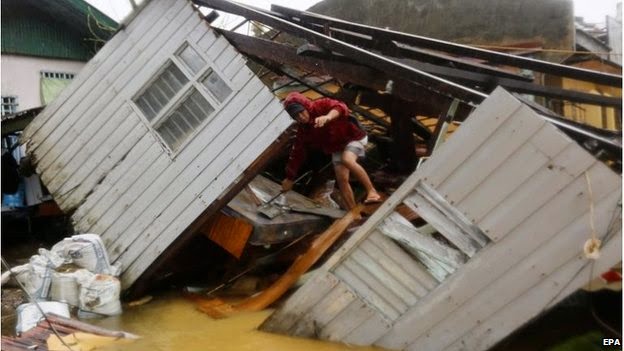
More than half a million people have fled coastal villages in the area, which was still recovering from Typhoon Haiyan last year.
In Tacloban, where thousands were killed by Haiyan, roofs have been blown away and streets are flooded.
But Hagiput does not appear to have been as severe as many had feared.
So far there have been no reports of casualties.
The BBC's Jonathan Head in Legazpi, about 200km (125 miles) north of Tacloban, said Hagiput was clearly a powerful storm but nowhere near as powerful as Haiyan.
The authorities believed they were well prepared this time, he adds, but it could be some time before the extent of damage in more remote areas becomes clear.
Officials told the BBC that lighter than expected rain meant there was less chance of landslides, but that the strong winds could still bring down trees on homes.
Read more at: http://www.bbc.com/news/world-asia-30365721
Subscribe to:
Posts
(
Atom
)